The spaces between “us” (inclusive) and “them” – aloha ‛āina is a kākou thing

Part 2 of 4 in our series on 'Resistance at Mauna Kea'

To read Part 1, click here.

Karin Louise Hermes, University of Hawai‛i at Mānoa

Until early April when the first arrests happened on Mauna Kea, I was entirely uninvolved in the issue, despite having witnessed my friends and classmates protesting the desecration on the University of Hawai‛i at Mānoa campus back in the fall of 2013. Since my support began by writing and blogging for one of the Mauna Kea protectors’ media outlets, I have made so many new connections in this movement to protect Mauna Kea and in the over-all Hawaiian sovereignty and independence movement.

There is always the question of positioning and voice (and when not to have one) in this discussion. In the Facebook groups and in articles written, many state their ethnic background and connection to Hawai‛i before giving their opinion. Some Kanaka Maoli commenters then say there is no need to always mention this as a defense for speaking on Hawaiian matters, it’s “a kākou thing”. However, I find it is actually necessary as a sign of respect, as well as a statement of solidarity and mutual understanding.

Over and over again by the TMT and the media, the Mauna Kea protectors are described as a small group of dissenting and “backwards” Native Hawaiians, indigenous people protesting for their privileges and rights to animistic beliefs and practices. A small group of people putting “religion” before “science”, and “progress”, while the reasonable majority supports the TMT. Anyone who actually cares to be informed and doesn’t simply accept the racism and American imperialism perpetuated, knows how large the group of protectors on the ground and in virtual space are. This is not at all about being “anti-science”, but about standing for what is pono. The authors of many of the articles written or even those standing in the line of arrest are academics from the University of Hawai‛i and other universities, Kānaka Maoli or not, scholars of social studies or law, astronomers, engineers and other scientists. The protectors and community organizers online are based out of the US continent bringing in their kuleana, their responsibility for taking care of the ‛āina, long-distance.

This is where I state my positionality of not being Kanaka Maoli or even living in Hawai‛i at the moment. My motivation for joining in the kākou, the ‛ōlelo Hawaiian inclusive “us” pronoun against the pro-TMT “them”, is not only from answering the call of support from my friends in Hawai‛i, but even more, from feeling the need to step away and speak up against the group with a settler colonialist mentality counter to the protectors and aloha ‛āina.

Based on my ethnic appearance (Filipino/Chinese/Spanish and German) and a perhaps more culturally-aware outlook from Pacific Islands Studies, I’m more often than not Othered or invited into the kākou anyway. Although I hold an even more unusual position in the movement, as I can’t be called a settler colonialist “ally”, as much as I am merely a malihini, a visitor, since I am without any immigrant status to the Hawaiian Islands with my EU passport. Because I’m aware that I’m an outsider, not native, not “local”, I recognize I shouldn’t confront any Kānaka Maoli who are against the protectors. I would be a hypocrite and just as paternalistic as the pro-TMT crowd that claims they know what is better for the people indigenous to the land, than they can know for themselves. Fortunately, because I’m also not white, I don’t get called haole or fear falling into a white savior complex either.

Holding this middle ground or more nebulous position between Kānaka Maoli and settler colonialism, I chose my involvement. I choose to protect Mauna Kea with aloha ‛āina as the essence of respecting the culture and people indigenous to the Hawaiian archipelago. Expressing aloha ‛āina, standing for Mauna Kea, protecting sacred spaces and showing awareness and understanding of the injustice, that is what is pono for Hawai‛i. It’s what is right. I have since learned that aloha ‛āina is not only the “love of the land”, but can also be translated to “patriotism”, a word of pride for US Americans. Aloha ‛āina is what separates the kākou from “them”, either you respect it or you don’t. It might be the biggest cultural misunderstanding for settler colonialists in Hawai‛i towards Kānaka Maoli who regard and care for the land as family. Either you support what is pono, or you respectfully know your place and know that to perpetuate the colonial narrative of violence and oppression is against the life of the land.

The racist e-mails that came out of UC Santa Cruz and Berkeley by prominent astronomers showed disconnect to the issue at hand. Racist and paternalistic remarks confirm the disregard for the people of the land and voice the sense of entitlement to what is not theirs to own or change. The internet comments under mainstream media articles or letters to the editor, the new state legislations after the June 24 stand-off that now restrict Kanaka Maoli cultural practices and access to the summit road on Mauna Kea, the prolonged duration of the impasse and Governor David Ige’s mention of deploying the National Guard, these are all strengthening the resolve of the protectors. The thing is, for outsiders not in the know, anything that doesn’t actively involve them is seen as not happening, and the confused commentariat says “but why are they only protesting NOW?”

April 2, 2015, and the arrests of 31 protectors were covered by the mainstream media and social media when prominent supporters raised awareness to what was going on. June 24, 2015, and the arrests of 12 protectors were witnessed by over 700 people and private and independent cameras to counter the local media that has their own biased depictions. My own awareness was raised in October 2013, when I first saw my personal connections involved. The aloha ‛āina protectors of this generation know there were always protests against the TMT project and previous observatories constructed on Mauna Kea over the decades, only now the voices are becoming louder.

As a malihini I feel it is more of my kuleana to call out fellow malihini. Kānaka Maoli have no kuleana or obligation to educate or “enlighten” visitors who don’t care to understand. My purpose for writing this and other articles is not to speak for Kanaka Maoli or to give myself the title “ally”, my purpose is to clarify to settler colonialists, haole, malihini, that this is not an “us” against “them” along ethnic lines, but a division by aloha ‛āina. My intention is to show to “them” that there is a greater movement happening that they are not seeing. The protectors are not only sustained by the pōhaku in the road and by the strength of the koa that the warriors emulate, but also by the people who give their signatures on petitions and the hashtags of #WeAreMaunaKea in virtual space, and by the generations of kūpuna standing with them in the spaces (maybe as star particles that the astronomers hold so dearly) between the lines with the love of family, the aloha for the ‛āina.
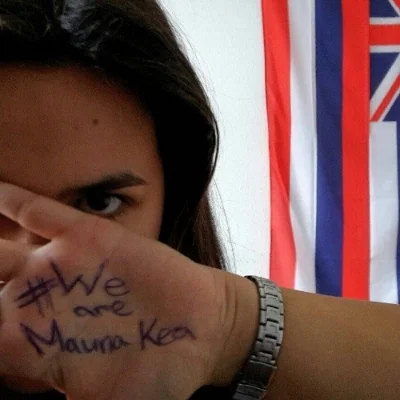
Karin Louise Hermes is currently based in Berlin, Germany, 12 time zones away from Mauna Kea, to get in touch with her native German roots while writing on aloha ‛āina. She holds a B.A. in Cultural Anthropology and Sociology from the University of H…

Karin Louise Hermes is currently based in Berlin, Germany, 12 time zones away from Mauna Kea, to get in touch with her native German roots while writing on aloha ‛āina. She holds a B.A. in Cultural Anthropology and Sociology from the University of Heidelberg and an M.A. in Pacific Islands Studies from the University of Hawai‛i at Mānoa.

We are Mauna Kea: Resistance in Diaspora

Part 1 of 4 in our series on 'Resistance and Mauna Kea'

Natalee Kēhaulani Bauer, UC Berkeley

On March 31, 2015, I posted a link to Facebook asking my friends to sign and support the protection of Mauna Kea from the development of another (fourteenth!) telescope on the sacred mountain.  Within minutes I received a response from an old friend, suggesting that I had been misled by the Internet: “Oh my gosh Natalee my mom is working to get this telescope built, don’t believe all you read, you should talk to her” [sic]. This friend – I’ll call her Diana – is a queer white woman, one whose politics occasionally align with my own, but more often they lean toward the homonormativity of the Human Rights Campaign (HRC), respectability politics, and neoliberalism at its finest. I knew already that her mother had been living in Hilo for the past five years or so working on an (until now) unnamed astronomy project for the UH.  A month before my post, Diana posted links to articles praising her mother for her work on the telescope; words that read like the archived diaries of 19th century white missionaries sent to bring morality and salvation to the “ignorant natives” in Hawai’i. Her mother, like so many settlers before her, was here to save us, to teach us “what’s best.”

I remained quiet when I read Diana’s initial posts praising her mother. I remained quiet (for a few hours anyway) after Diana commented on my post, informing me that her mother, a white settler working for the University, knew more/better than I, a Kanaka Maoli scholar and activist. I politely answered Diana’s post, letting her know that I was, in fact, quite well informed, and then asking, “I wonder why you'd suggest I'm being misled, rather than it is you (or your mom) being misled or unaware of ongoing indigenous struggles to protect Mauna Kea?” And then I went to bed, raging, hurt, offended, and overwhelmed by that familiar feeling of erasure.  This is how whiteness works.

The next morning’s replies from Diana showered me with more “lessons” on (1) her mother as a “Christian and community liaison” (therefore a “good guy” and someone whose understanding was more complex than my own), (2) the fact that “many many Hawaiian residents, 100's more than those protesting have decided this is good for Hawaii” [sic], and (3) how disappointed she was in my “refusal to participate in conversation” regarding the TMT (translation: my refusal to agree with her interpretations of the project). My response to her? “What you have described here is the greatest example of settler colonialism I have ever seen.” And then she was silent, and my motivation to keep Mauna Kea in the spotlight here in California, across my social and academic networks, was renewed. This is how resistance begins.

I am writing this post today as a Kanaka ‘Ōiwi in diaspora, far from home, and never having set foot on Mauna Kea, nor Hawai‘i Island, for that matter. From where I sit, from this distance, I interpret the mainstream discourse around Mauna Kea, the TMT, and the protectors as yet another example of the cause and effect of centuries-old erasure of the Hawaiian people and our culture.  As many others have noted, opponents of the TMT are caricaturized as stuck in the past, anti-science, and band wagon activists, and we are discursively reduced to misguided hordes of angry natives getting in the way of progress for no good reason. The growing movement to protect Mauna Kea is a refusal of this discourse, a refusal to be silenced, and a demand to be heard in a digital age wherein our names and our voices can no longer be hidden away and ignored. It is also important to note that the refusal and resistance we see today is not new, nor is it a hasty, last minute response (as many critics have claimed). Our resistance is more broadly visible outside of Hawai‘i, thanks to social media; however as Goodyear-Ka’opua, Hussey, & Wright demonstrate in their edited anthology, A Nation Rising: Hawaiian Movements for Life, Land, and Sovereignty, Hawaiian resistance to settler colonialism (and to all thirteen other telescopes on Mauna Kea) has been a relentless force for centuries.

In writing about the resistance at Mauna Kea, I can only speak from this distance, which at times feels immeasurable. I cannot speak for Ku Kia‘i Mauna, the protectors on the mountain, though I would like to speak to them and reflect back across the Pacific what their efforts mean to those of us far from home and family, assaulted by American entitlement toward Hawai‘i as their perfect paradise, rendered invisible and ungrounded again and again. I am speaking now to the aloha āina warriors, to those who were arrested yesterday and removed from the mauna due to the governor’s invention of new rules, to those who have worked to bail out and legally defend the aloha āina warriors, to those who are still on the mauna, to those who have advised and enforced kapu aloha during this ongoing struggle. I want to tell them that their perseverance gives me sustenance, and their love for the land and the people overwhelms me with emotions almost impossible to contain. I want to tell them that they are not merely protecting one mountain, but they are breathing life into our people, at home and in diaspora, filling us with a renewed sense of self that is so clear and deeply rooted that it leaves no room for the false narratives, nor the attempts at erasure and engulfment by settler colonialism and Americanization. Witnessing the movement grow and spread across the globe makes me indelibly “real” again. I am no longer silent, invisible, or necessarily rendered white. I am Kanaka Ōiwi, and I am Mauna Kea. Kū Kia‘i nā Mauna. Kū‘e!

Natalee Kēhaulani Bauer is a Kanaka Maoli (Native Hawaiian) doctoral candidate in Social and Cultural Studies in Education, at the Graduate School of Education, University of California, Berkeley. She is also a part of the Designated Emphasis progra…

Natalee Kēhaulani Bauer is a Kanaka Maoli (Native Hawaiian) doctoral candidate in Social and Cultural Studies in Education, at the Graduate School of Education, University of California, Berkeley. She is also a part of the Designated Emphasis programs in Gender, Women, and Sexuality, and in Critical Theory. Outside of academia, Natalee was a public school teacher and administrator for ten years, she is a brown belt in Kajukenbo Kung Fu, and most importantly she is mommy and favorite playmate to the world’s funniest 2-year-old boy.

Resistance at Mauna Kea: Blog Series Intro

On June 16, 2015, the Critical Ethnic Studies Association issued a statement in support of the kia‘i of Mauna Kea-- the inspiring, committed protectors of a sacred summit on Hawai‘i Island. The kia‘i are fighting to stop the construction of a proposed Thirty Meter Telescope, which would destroy many cultural and environmental resources of Mauna Kea. Nearly two months later, the kia‘i continue to stand strong on the mountain, despite increased policing, new "emergency rules" and arrests, as well as the Governor suggesting the possibility of the National Guard being called out to remove the kia‘i. In the face of violence, the kia‘i continue to maintain a practice of kapu aloha, a discipline of compassion, kindness and love, towards all. In order to further share information and foster support of the struggle at Mauna Kea, as well as a similar struggle over a proposed telescope on Haleakalā on the island of Maui, we offer this blog series. We will be featuring writing from many Kanaka Maoli and allies involved with organizing for Mauna Kea in Hawai‘i and elsewhere. For those interested in finding ways to support, from signing petitions to donating to legal defense funds, check out our list of places to start here.

Maile Arvin, Ph.D.

Assistant Professor of Ethnic Studies

University of California, Riverside

CESA Journal Volunteerful Spot

Soon, the Critical Ethnic Studies Association Journal is launching a blog made of several short series (see below). The goal for the blog is to be a bit meta, a bit funny, a bit backbiting, a mix of fresh and sweet and inspired and pointed.

We know from spending time with you in Toronto, Chicago and Riverside that you are smart, delightful and hilarious. You've got a way with words and we want you to come this way with them.

Check out some of the topics we're considering below, and suggest some of your own.

New! Extended priority date August 30, 2015

We'll be in touch to ask you to craft posts on one or more topics. Posts will be anywhere from 400-1,200 words, and we'll plan a July-August due date with you.

In the meantime, we'll also be circulating two new calls for journal papers: an open call and a call for our special issue on what justice wants.

You can always get in touch via this address: justice@criticalethnicstudies.org

Talk soon--
Eve Tuck & K. Wayne Yang (Critical Ethnic Studies Journal Editors)

Volunteer to write for the Critical Ethnic Studies Journal Blog