Technologies, Pedagogies, and Performances of Resistance

A'Keitha Carey, Texas Woman's University

This summer has been full of challenges. I recently ended a one-year contract at a university in the mid-West, worked on several essays and articles for publication, prepared for my qualifying exam for my PhD studies, presented at the National Black Arts Festival in Atlanta, and packed to prepare my three-day drive cross country to relocate to New York. It has been hellish!

For this blog, I will focus on my experience at the National Black Arts Festival as it serves not only the topic for this blog but also fosters great fuel for my both my academic and personal lives.  I presented CaribFunk, a dance technique and social movement that I developed as part of the National Black Arts Festival Symposium titled: “Dance Across the Diaspora: A Historical Lens on a Black Cultural Movement” developed and moderated by Professor Thomas F. DeFrantz, a dance historian, dancer, choreographer, and scholar. CaribFunk is a fusion of Afro-Caribbean (social and traditional), classical ballet, modern, and fitness elements and principles.

The experience as a participant was both validating and inspiring as the theme of each workshop and/or presentation was centered on: Survival, Identity, Cultural Integrity, “Black and U.S. Social Dance as Resistance,” and The Technologies of Indigenous People of Color in the Americas Revealed Through the Lens of Performance. Resistance in motion and embodied protest were illustrated throughout the day-long symposium. Each panelist shared their personal stories of how dance and Diaporic sensibilities and expression informed their articulation (physical and oral) of their particular narratives.

For ritual community members, the dance/music performances suggest myths and retell cultural stories, but most important, they charter and encourage social behavior in present everyday lives. (Daniel 2005, 1)

Each presenter discussed the “radical” social movements that were constructed through performance that functioned as a form of embodied protest, revealing “what the body knows, [and] what it is capable of” (Daniel 2005, 4-5). Dancers demonstrate a “resilient and exciting ritual performance [in this instance] dance and music embody memory and perseverance and, in the end, inspire and support survival” (Daniel 2005, 5).

Three examples of African communities that resemble survival, resistance in motion and embodied protest are Capoeira in Brazil, the Jamette’s in Trinidad, and Jamaican Dancehall. As I listened, observed, and participated in the symposium, I reflected on the history of each social movement and how elements of these cultural movements and performances could be traced in several of the presentations at the festival. To provide some context, I will proffer some historical background to support my declaration.

Capoeira in Brazil:  Capoeira, “An Afro-Brazilian art” premised on principles of resistance is a clandestine practice that was disguised as a dance.  This strategy was used to resist those who policed and prohibited Blacks them from performing the “martial arts technique and choreographic and rhythmic vocabularies [that] were brought from Africa” and allowed them to “practice their games in seclusion” (Browning 2001, 166).

Prior to their captivity and enslavement in Brazil, the people of the Kongo-Angola region practiced certain kicking games for sport and recreation … In Brazil, the games were prohibited for all too obvious reasons. (Browning 2001, 166).

Capoeiristas perform an embodied protect, a physicalized activism that functions as a “technique of resistance” (Browning 2001, 166). This system of movement is “outside of the [upper] class [expectations], status quo and aspirations,” signifying an oppositional stance in [Brazil’s] “race-class hierarchy” (Niaah 2004, 103).

Many of the panelists discussed the oppositional or the political resistance that they either performed or encountered and the Afro Diasporic traditions that can be traced in their research. This was particularly evidenced in dance scholar, Dr. Osumare’s presentation on “They Were BAAD: Black US Social Dance As Resistance” where she examined “Black Badness in Dance.”

The Jamette’s in Trinidad:

From the late nineteen to the mid-twentieth century, the poor black women who defied standards of propriety and retaliated against her dehumanizing position in society was referred to as the jamette. Although the jamette is no longer a symbol of disorder and licentiousness in Trinidad, her impact on the corporeal expression of the contemporary woman in Carnival is unmistakable. (Noel 2010, 60)

This ideology has certainly set the tone for women’s morality, administering and proscribing how they should perform in social spaces. The movements of the pelvis were abhorred and those that performed such movements were policed and vilified.

The 1980’s would be pivotal in respect to the way women moved during Carnival, with the majority of women masquerading by wining and gyrating without reservation. The disconcerted reactions to these public acts of transgression were immense, and the behavior soon became a moral and sociological issue on a national level. (Noel 2010, 61)

The dance technique CaribFunk is premised on the activism and embodied protest exhibited by the Jamette’s in Trinidad, focusing on the hip wine (circular rotation of the hip. CaribFunk locates “the politics of identity and subversion through the exploration of the hip wine (circular rotation of the hips) often found in the stylistic and virtuosic performances of Jamaican Dancehall and Trinidadian Carnival (Carey 2015).

Jamaican Dancehall:  Dancehall is considered by some to be a musical genre, social movement, and space.

It flourished in Jamaica around the 1950’s, and its name derives from the exclusive space, or ‘halls,’ in which dance events were held. It tells the story of a people’s [inner city and of lower socio economic backgrounds and culture] survival and need for celebration of the survival against forces of imperialism and systems of exclusion through dance, music, and attitude. Dancehall’s story is ultimately the choreographing of identity that critiques aspects of Western domination. (Niaah 2004, 103)

Panelist, independent artist, and international street dancer Storyboard P discussed his street dance technique which he defines as a “mutant style” which is a fusion of “bruka from Jamaican culture and ‘flexin’ in the streets where animation rules.” Storyboard P stated that his style was developed “from his pain and isolation of being beat up.”

… The movement is continuous, like the body must be constantly reminded that it is not in control.

… I said “I want to ask you about pain”
He said, “It’s funny that you say that, pain is the backdrop to all I do”

… And there you have it. (An excerpt of Onye Ozuzu’s reflection on Facebook 2015)

The day began with a participatory workshop in “CaribFunk” taught by myself and ended with a participatory workshop “Technology of the Circle” taught by Onye Ozuzu, the Dean of Fine and Performing Arts, Columbia College Chicago. Onye’s “Technology of the Circle” is a methodology used as a form of communication, to tell a story and to problem solve, very similar to how the roda functions in capoeira—the same circle formation that delimits all traditional Afro-Brazilian dance” (Browning 2001, 165).

The festival functioned as a technique of resistance providing meaning making and storytelling through embodied protest, allowing participants to become practitioners of the techniques taught. I left Atlanta with a sense of renewal and a calmness that was much needed as I prepare to venture into the next chapter of my life.


A’Keitha Carey is an independent artist/scholar originally from the Bahamas. She completed her Certificate in Women's Studies from Texas Woman’s University where she is currently working to complete her PhD (Dance). A'Keitha created CaribFunk™ techn…

A’Keitha Carey is an independent artist/scholar originally from the Bahamas. She completed her Certificate in Women's Studies from Texas Woman’s University where she is currently working to complete her PhD (Dance). A'Keitha created CaribFunk™ technique, a genre fusing Afro‐Caribbean (traditional and social dance), classical ballet, modern, and fitness principles and paradigms. Using her island gal sensibility she writes about theories and topics in the areas of: Dance Studies, Feminist/Womanist Thought, Critical Pedagogy, Critical Race Theory, Ethnic Studies, and Cultural Studies.

Browning, B. 2001. "Headspin: capoeira ironic inversions.” In Moving History/Dancing Cultures: A Dance History Reader, eds. A. Dils and A. C. Albright, 144-151. Middletown, CT: Wesleyan University Press. 

__________. 1995. Samba: Resistance in Motion. Bloomington, IN: Indiana University Press.

Carey, A. 2015. CaribFunk: A Melange of Caribbean Expressions in a New Dance Technique. Hemispheric Institute of Performance and Politics-Emisferica <http://hemisphericinstitute.org/hemi/en/emisferica-121-caribbean-rasanblaj/carey>

Daniel, Y. 2005. Dancing wisdom: Embodied knowledge in Haitian Vodou, Cuban Yoruba, and Bahian Candomblé. Urbana, IL: University of Illinois Press.

Niaah, S. S. 2004. Kingston’s dancehall: A story of space and celebration. Space and Culture 7 (1): 102-118.

Noel, S. A. 2010. De jamette in we: Redefining performance in contemporary Trinidad Carnival. Small Axe 14 (1): 60-78.

Ozuzu, O. 2015. Storyboard P Reflection. <https://www.facebook.com/profile.php?id=10234649&fref=ts&ref=br_tf> Posted July 19, 2015.

What my summer would be

Part 2 of 3 in our series on "What I am working on this summer"

To read Part 1 click here.

Sean Labrador y Manzano, Independent Scholar

Stormy Friday night, more tease than relief of the pending drought, February 6, 2015, the “Frank O’Hara ‘Lunch Poems’: 50th Anniversary All-Star Reading” at the McRoskey Mattress Company in San Francisco set the tone of what my summer would be, what my future should be. I count a handful of POC in the audience, a tendency of mine attending three readings a week for the past several years, betrays the demographics of the Bay Area. I count many friends, many instructors, many acquaintances, and many MFA students who have read for me at my monthly Mixer 2.0 at the Cat Club. After 3 hours, I catch up with a Professor and was asked how was the beginning of my year.

I offered the unusual, “I am feeling great!”

Then the, “Why?”

“I have been accepted to panel at two conferences.”

“And you’re going?”

“Of course not. I never do.”

To the obvious puzzlement, I explained how I fish through the UPenn Dept of English call for papers and as an exercise submit proposals to attractive panels. I mean why stop because I am no longer in grad school? When a proposal gets accepted, I wait a week before sending a letter sadly declining the invitation. Travel restricts participation. I have skipped several conferences.

The Professor says, “We will need to change that.”

First, The Circle for Asian American Literary Studies accepted my presentation, “From Trauma to Catharsis: Performing the Asian Avant Garde” for its session on “Trauma and the Asian Diasporic Literary Imagination” at the 26th annual conference of the American Literature Association, May 21-24, 2015 Boston, MA. In the original multi-media proposal I claimed to present observations and conclusions, successes and inadequacies of a three-day symposium in August 2014 I curated at the California Institute of Integral Studies, “From Trauma to Catharsis: Performing the Asian-Avant Garde.”

However, watching through social media, mostly Facebook, the fallout of Kenny Goldsmith’s Michael Brown’s autopsy report reading and later Vanessa Place’s Hattie McDaniel—how friends turning against each other defining appropriation and racism, to the point where boycotts and threats against Vanessa Place and any institution or person accommodating her, for example the AWP 2016 Los Angeles and the much anticipated (50th anniversary) Berkeley Poetry Conference, June 15-19, I reacted to steer my presentation along the lines of a genealogical search for an Asian Avant Garde, whatever that means, and where are the roots in the San Francisco Bay Area. I paired text with the video of a waterboarding performance in which I am rendered by an anthropologist. Speaking English is like drowning. My English suspected. I was so amazed by how people who are allied in many areas of the social, the cultural and the political were fracturing because of the sides taken because of Vanessa Place. And yet we all dip from the same fountain?  Kelsey Street Press’ MG Roberts drove me to SFO. For last minute edits to my presentation, I borrowed her copy of Nests and Strangers: On Asian American Women Poets edited by Timothy Yu and released by Kelsey Street Press earlier that month. In exchange I was to write a review (didn’t) during my flight. Somewhere above Missouri, when the Lebanese Northeastern University engineering undergrad next to me finally fell asleep—we started talking about his Pilipina nanny, I read the fourth and final essay in which Dorothy Wang frames Bhanu Kapil in the context of Kenny Goldsmith. Kenny Goldsmith!—I rested my head on the tray figuring how to reconcile him in this essay written a couple years before his poetry reading of Brown’s autopsy. At the conference, on a sufficient diet of cocktail hour hors d'oeuvres and vodka cranberries, thankful that I did not hear the name Baudrillard or post modernism in any of the sessions I sat in attendance, I medicated myself from being an “Independent Scholar” and savored how much I wanted institutional affiliation and the resources to conduct research. From Boston, I watched the rumors that maybe the BPC would be cancelled.

Second, Professor Jim O’Louglin accepted my multi-media presentation, “The Person Sitting in Darkness Writes Back: Mark Twain’s Pilipino and Chamorro Poets in a Time of Terror” for his “Mark Twain and the North American Review” panel at the bicentennial anniversary of the North American Review, June 11-13, 2015, University of Northern Iowa in Cedar Falls. I must have read Twain’s 1901 essay “To the Person Sitting in Darkness” in high school alongside Conrad’s Heart of Darkness. In the original proposal I claimed to discuss how Twain anticipated such writers like Barbara Jane Reyes, Ronaldo V. Wilson, Aimee Suzara, Lehua M.Taitano, and Craig Santos Perez. The result of teaching colonial subjects to speak and think in English, is a literati interrogating the very empire that supplied history. I would have needed more than the allotted time to do them justice.

Instead, in my exhaustion reading social media accounts of poets discrediting other poets or poets elevating other poets for being more socially acceptable, I decided to just emphasize how Twain’s essay is prophetic and timeless. I will return to these writers and their contributions another day. Furthermore, to include how the essay addresses current events, I was waiting for the Department of Defense to release official news reports and photography of the annual Balikatan exercise. While as much the exercise is about U.S. and Philippines military interoperability, it is also about humanitarian aid. The Seabees every year erect schoolrooms and the children are organized to dance their appreciation. In several of the photographs, marines landed on a familiar beach, identifiable by Camara and Capones islands in the background. In one telling pose, a marine points a rifle seemingly and harmlessly down range, I follow its barrel, to the direction of my mother’s property. Twain protested the Philippine American War, the seizure of the Philippines, the military atrocities such as waterboarding, and the growing fatigue and complacency of news reporting and lack of outrage.

I began the presentation with two US Navy recruitment campaigns. “America’s Navy: The Shield” was released in late 2014. I do not think a three-person family needs the protection of a huge military. With such comfort, the nation can go on the offensive. “U.S. Navy: Pin Map” was released early 2015. Notice the U.S.S. Ronald Reagan spearheading the Asian pivot. Towards the end, the view rises above Guam, then enlarges to include the Philippines, and China. Can a poet really stop the arms race in the East Philippine Sea?

Still with my professor’s support, I flew to Denver, then rendezvoused with three panelists in Boulder, from there drove 12 hours to Cedar Falls. Driving back on Sunday.  The road trip reminding of Futurist manifestoes past metallic tepees, I am more certain risking a late career PhD.

Between the two conferences, the BPC evolved in to “Crosstalk, Color, Composition: A Berkeley Poetry Conference,” one day less, and 10 featured writers fewer. When I returned from Boston, I wrote to the BPC asking it to not cancel, sharing many concerns that I will not go in to detail. When I returned from Iowa, I was assigned the Wednesday afternoon seminar, “Asian-American Avant-Garde.” Whereas the CAALS presentation was 20-minutes long and the Twain presentation was 15-minutes long, the CCC presentation was 40-minutes long, or a blending of the two. At the time of this blog entry, I am attempting to rerecord the audio portion of the presentation to be archived. It will lack the urgency, the anger, the palpitating speed, the improvisation, and the dark humor.

As a result of Boston, I will be leading a CAALS roundtable at the 2016 ALA conference in San Francisco. Hopefully, through CFP, and elsewhere, I will soon post a call for proposals on the Mixed-Race Asian Avant Garde.

As a result of all three conferences, I have amassed enough persuasive material, I hope, to enter a PhD program in Race and Ethnicity, Transnationalism and the Pacific Rim, and Militarism. So working on applications is next.

In the momentum, I had proposed an AWP 2016 craft panel on writing buried histories within poetry, inspired by Mark Twain’s outrage of the Moro Crater Massacre in March 1906—the newsworthiness only to be eclipsed by the San Francisco Earthquake. Three days ago the AWP rejected the proposal but I am still convinced I need to organize some kind of memorial reading of the 600+ Muslims killed because dialogue was not favored—because the United States is rebuilding its presence in the archipelago, and in that presence, a surge of radicalization, and the precedent for combat operations.

Sean Labrador y Manzano resists gentrification on the island off the coast of Oakland where on sunny mornings reenacts Caliban sleeping on unflagged beach.

Sean Labrador y Manzano resists gentrification on the island off the coast of Oakland where on sunny mornings reenacts Caliban sleeping on unflagged beach.

Love/Whole in Summer


Part 1 of 3 in our series on "What I am working on this summer"

Stacey Gibson, Educator/Independent Consultant

The beautiful struggle of the CESA conference is the full-bodied volume of old world, save your soul ancestral directives tangled and tossed with the thick new growth of inquiry/answers and explorations. Having attended the Chicago conference in 2013 and the recent Toronto conference, I am left with wonders, both heavy and airy. I returned to Chicago eager to seek out conversations and practices that did not soft step what it means to inhabit, embody, exorcise, resist, and check for the tentacles of colonization.

To live in a ‘third’ world* seductively and nastily masquerading as a ‘first’ world ain’t for the faint. So for me one way in/out is to massage the sweet spots of creativity, drive, silence and such and allow them enough breathing room when they reveal and unveil themselves. One of the many sweet spots, at least for now, is the ink pen. Since returning from CESA, some recent short fiction pieces I have been editing, creating, and revising are a series of desire/love stories that are ripe with love giving, love taking, love sharing, love leaving, love making, and love movement. Some of the stories have been in process for a longer period of time and others are fresh blooms. Then comes another sweet spot of how to balance those love-ing stories with a second project which is writing a long overdue critical essay on colonizing intellectual experiences by race gazing and fetishizing the darker body in school classrooms.

While the bodies of writing are seemingly different, as I work on each project I am intrigued by the way closeness, proximity, and the negotiation of perceptions fold into each piece of writing. These developing projects are propelling me to read silences both with intense ferocity and tender eyes, for it is in the silences that unique and virtually untraceable manifestations of power are revealed, wielded, normalized, and enacted.

Recently I’ve been reading older interviews of James Baldwin and watching his televised debates. Among the many ideas I have formed based on his oration is that to write about and say ‘the thing’ that results from ‘the shattering’ is the practice and process of what I call “whole-ing”. There is a more whole truth to tell, say, and write than any digitally mutilated bits, bytes, and pics can offer. There reverberates a more whole sense of what is and is not happening on this planet; a sense that is just as much in the belly as it is in the mind as it is in energy meridians. And finally, there is a whole-ing of the self that is no longer negotiable. Much depends on being whole, full beings in a world of systems often trading on magnificent caches of that which is shattered. As I enjoy thinking about this process of “whole-ing” it is not to amplify victimization as much as it is to practice the most natural thing ever which is to be and love the whole entire self.

While there are a host of other projects and realities in my to-do queue (facilitating anti-oppression workshops, college tours with my child, writing conference reviews, rethinking relationships, writing proposals, reading my newly revealed Meyers Briggs profile (the hell?), visiting mountains), it is these pieces of writing that help me practice steadiness and manage the urgent necessity and natural inclination towards being my own whole self. Head nods and a raised fist to the daily grind of being true, whole, and free. That is what this summer has provided for me thus far.   

Notes: *Third world & first world references are, to me, false indicators, a textbook example of mislabeling in order to perpetuate tomfoolery and confusion.          

________________________________________________________
Caribbean born Stacey Gibson is a Chicago area parent, educator, and consultant who is committed to whole story truth-telling.  Her teaching experiences with children, adults, parents, and administrators in both public and private schools provides her with unique access to vastly different educational models.  Though Gibsonholds a M.Ed in Educational Leadership, her deepest learning comes from ongoing discourse, incessant reading, and unapologetic questioning. Long live the cipher! She would like to thank the nameless ones who preceded her because she knows she could not be without them. 

A Year After the Ferguson Uprising, Reflections on Mauna Kea

Part 3 of 4 in our series on 'Resistance at Mauna Kea'

To read Part 1, click here. To read Part 2, click here.

Laurel Mei-Singh, CUNY Graduate Center

As we mark the one-year anniversary of the Ferguson uprising catalyzed by the shooting of unarmed 18-year-old Michael Brown in Missouri, people are gathering from the summit of Mauna Kea to the streets of Waikiki to oppose the Thirty Meter Telescope (TMT) on the top of Hawai‘i’s highest mountain. We are demanding the protection of land, resources, and sacred sites across the islands. In this struggle, we are declaring: Kū Kia‘i Mauna! (Stand Protectors of the Mountain!)

What do the Black Lives Matter and the Kū Kia‘i Mauna movements have in common?

From Hawai‘i to Ferguson to New York City, we are arriving at a tipping point. In this post-9/11 era of endless war, environmental destruction, financial crisis, and gentrification, everyday people are facing a new degree of insecurity and precarity. In response, people are rising to reclaim our land, our streets, and our lives. We are also witnessing a new round of policing and enclosure to contain these movements for justice.

On August 7, 2015, the Wai‘anae Coast community (a poor and working class predominantly Hawaiian and Pacific islander part of the island of O‘ahu) hosted a community event on Mauna Kea. An audience member, Pake Salmon, asked why $1.4 billion is going toward astronomy research when we are barely surviving on the planet on which we live. UH Law School professor Williamson Chang later pointed out that we are living in a time and place in which we are mired in debt, most of us can barely afford a place to live, and it takes three hours to drive 23 miles on the H-1 during rush-hour. Not to mention that military bases continue to occupy nearly a quarter of O‘ahu’s land. Hawai‘i is becoming increasingly unlivable, and, in response, Kānaka Maoli (Native Hawaiians) are rising up to reclaim their lands and lives, a driving sentiment behind the Mauna Kea struggle.

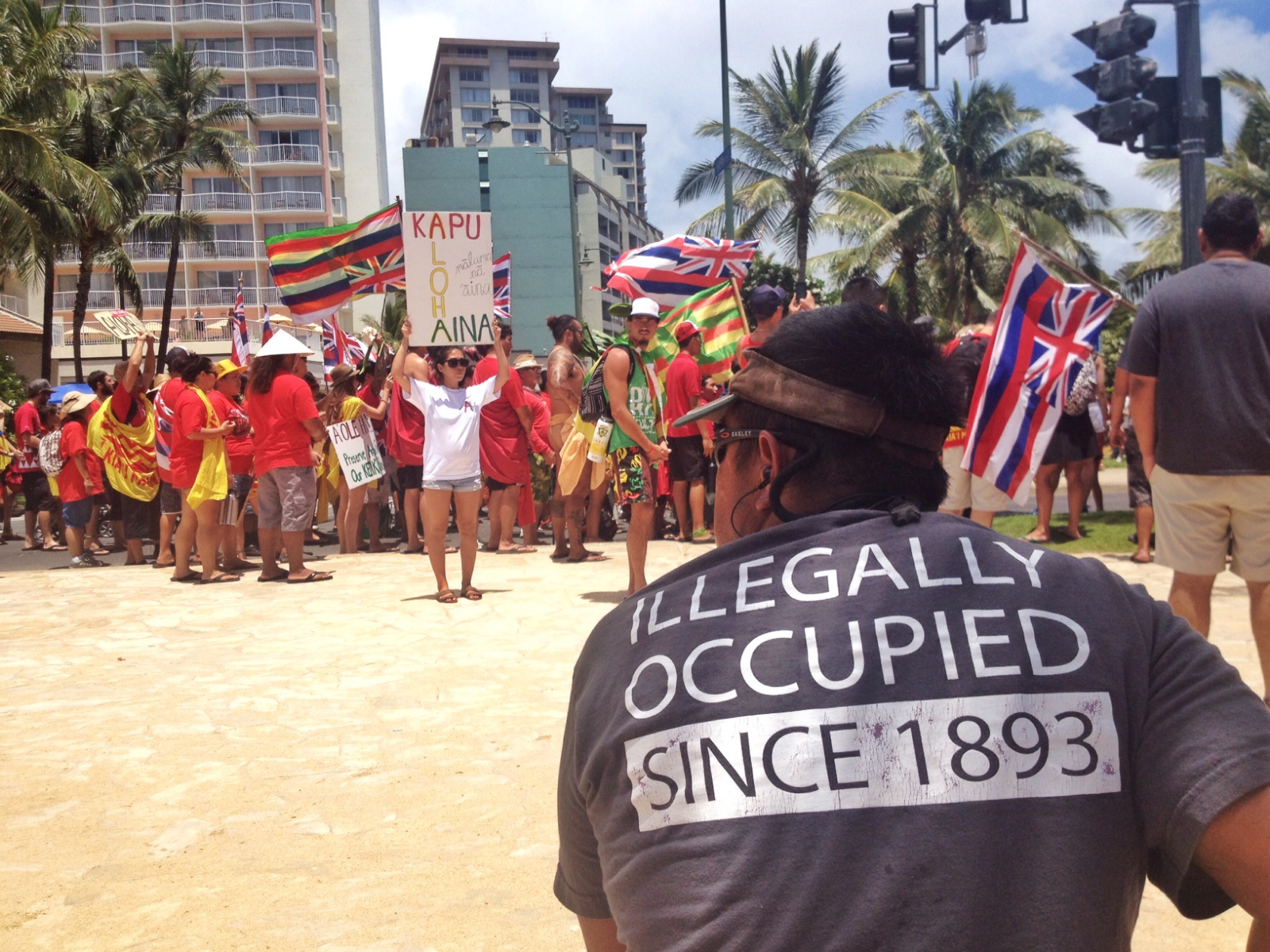
People brought this movement to Waikiki streets on Sunday, August 9, when thousands dressed in red participated in the Aloha ‘Aina march. In addition to the protection of Mauna Kea, demands included the protection and promotion of sustainable agriculture, specifically crops that do not rely on toxic pesticides and genetic engineering. After the march, community leaders spoke out against the hypercapitalism advanced by the Trans-Pacific Partnership and the illegal overthrow of Hawai‘i’s queen in 1893, calling for Hawaiian independence. Some wore T-shirts memorializing Kollin Elderts, an unarmed 23-year-old Hawaiian man, shot and killed by Christopher Deedy, an off-duty federal agent, in a Waikiki McDonalds during the Asia Pacific Economic Cooperation meeting in Honolulu in 2011. After he shot Elderts, Deedy claimed he was "protecting" the other people in the restaurant and was acquitted of his crime, despite the fact that witnesses say he was drunk. So far, five people in Hawai‘i have died at the hands of the police this year, including a man tasered to death on March 16, 2015, which the Honolulu medical examiner ruled a homicide.

Across the world, police are increasingly using militarized law-and-order tactics to maintain racial and economic hierarchies in the name of “public safety.” According to an arrestee at the August 7 Wai‘anae event, the number of arrests conducted by the State of Hawai‘i’s Department of Land and Natural Resources (DLNR) enforcement officers at Mauna Kea has reached 70. Hawai‘i Govenor David Ige signed new “rules” on July 10, blocking their access to the road at night and forbidding tent and other camping structures. The enforcers of these arrests and rules are the Division of Conservation and Resource Enforcement (DOCARE) officers of the DLNR who have “full police powers [to enforce] all State laws and rules involving State lands, State Parks…as well as…county parks.” In Hawai‘i, DOCARE officers police conservation areas, and they are increasingly harassing subsistence practitioners in places like Ka‘ena, a fishing ground on the westernmost tip of O‘ahu.

Many people in Hawai‘i—from fishers to hunters to activists—have remarked recently that DOCARE’s policing has amplified in recent years (even though one officer cried as he made arrests on the mountain summit). Lori Halemano, one of the arrestees from Mauna Kea, confirmed this amping of policing when I spoke to her after the Wai‘anae event. When I asked her why, she replied: “people are rising up.” They’re learning about Hawai‘i’s history and the ongoing illegal occupation and joining the struggle for Hawaiian independence. As DLNR and DOCARE claim to “protect public lands” through the arrest and removal of protestors who are challenging the very meaning of this concept, we must acknowledge that a major function of policing is the containment of the real threat that a movement of people pose to an existing social order.

Shelley Muneoka of the KAHEA: Hawaiian-Environment Alliance stressed to the Wai‘anae audience that the Mauna Kea struggle is about who has the power and authority to decide how land is used. Similarly, the Black Lives Matter movements in places like Ferguson, New York City, Charleston, Baltimore, Texas, and Oakland are fundamentally about who has power and authority over our streets, lives, and living space. As a diasporic woman of color from Hawai‘i who lived part-time on the islands over the last couple of years while making my primary home in Brooklyn, I see that both movements can learn from each other. For the movements against racist policing in United States urban centers, we must align ourselves with movements for indigenous self-determination, and the understanding that our relationships with land are fundamental to all of our survival. For the movements in Hawai‘i, we must acknowledge that we are fighting the same military and police machinery that working class people of color in the U.S. are up against, and we are not alone in our fights for justice and self-determination.

Laurel Mei-Singh is a doctoral candidate in Geography at the CUNY Graduate Center earning a certificate in American Studies. She was born and raised in Honolulu near the base of Leahi (Diamond Head) and currently lives in Brooklyn, New York.

Laurel Mei-Singh is a doctoral candidate in Geography at the CUNY Graduate Center earning a certificate in American Studies. She was born and raised in Honolulu near the base of Leahi (Diamond Head) and currently lives in Brooklyn, New York.